KAWASAKI 12021-1019 Reed Block Cage 12201-1029
fits model: Kx250, Kx, 250. make: Kawasaki. year: 1983–1985.
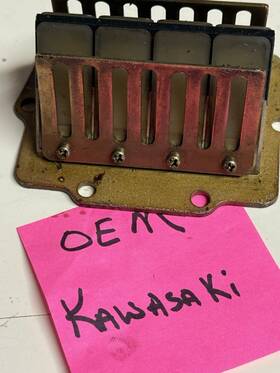
( Manufacturer Part Number: 12021-1019 ), ( Part Type: Block Cage ), ( Color: Multicolor ), ( Material: Aluminum ), ( Vintage Part: Yes ), ( Country Of Origin: Japan )
Review KAWASAKI Original Oe Oem Reed Block Assembly Cage fits KX250 KX 250 1983–1985
The Kawasaki KX250 from the early 1980s, specifically the 1983 model (part number 1983-1019) and its successor, the 1984-1985 versions (part number 1984-1985), represents a legendary era in motocross history, where Japanese engineering pushed the boundaries of off-road performance with precision and innovation. Central to the reliability and responsiveness of these iconic machines is the **Reed Valve Block (part number 12021-1019)**, a critical component that governs the airflow into the engine, ensuring optimal power delivery and smooth operation. Crafted from high-grade aluminum, this block houses the reed valves a system of lightweight, spring-loaded flaps that open and close in response to engine vacuum, allowing air to enter the cylinder at precisely the right moment. The design is both simple and brilliant, eliminating the need for complex valve trains while delivering exceptional efficiency, especially at high RPMs where traditional poppet valves might struggle. For the 1984 and 1985 KX250 models, the reed block integrates seamlessly with the updated engine tuning, which refined the powerband to offer a more aggressive mid-range punch and improved throttle response, making it a favorite among racers and enthusiasts alike.
Complementing the reed block is the **Reed Cage (part number 12201-1029)**, a sturdy assembly that holds the reed valves in place and directs airflow with precision. Constructed from durable steel, the cage is designed to withstand the intense forces generated during high-speed riding, ensuring that the reeds remain aligned and functional under extreme conditions. The cage s design also incorporates a smooth, tapered interior that minimizes turbulence, allowing the reeds to operate with minimal resistance. When paired with the reed block, this cage creates a cohesive airflow system that enhances both power output and engine longevity. The 1984 and 1985 KX250 models, in particular, benefited from subtle refinements in the reed valve assembly, which improved reliability and reduced the risk of reed flutter a common issue in early motocross engines. Together, these components exemplify Kawasaki s commitment to performance-driven engineering, delivering a balance of power, durability, and ease of maintenance that remains unmatched in its era.
For collectors, restorers, and riders seeking to preserve or enhance the authenticity of their Kawasaki KX250, these original reed block and cage assemblies are essential for maintaining the bike s historical integrity and performance. Whether used in a classic race machine or a meticulously restored show bike, the 1983 reed block and the 1984-1985 reed cage represent the pinnacle of Kawasaki s early motocross innovation. Their inclusion ensures that the engine breathes with the same efficiency and spirit as it did when the KX250 first dominated the tracks in the early '80s, making them indispensable for anyone who appreciates the raw, unfiltered power of a true motocross legend.
### **Pros and Cons of Buying a 1983 1985 Kawasaki KX250 with Reed Block and Cage**
#### **Pros**
1. **Classic Off-Road Design** The KX250 from this era is a well-regarded motocross bike with a lightweight frame, durable construction, and a reputation for reliability. It was designed for aggressive riding, making it a favorite among enthusiasts.
2. **Strong Engine** The 249cc single-cylinder engine (with a reed block in the 1983 model and a cage in later years) was known for its smooth power delivery and durability. The 1984 1985 versions with the cage carburetor were slightly refined for better throttle response.
3. **Proven Reliability** Kawasaki s early 1980s motocross bikes were built to last, especially when properly maintained. Many still run strong today with basic upkeep.
4. **Modding Potential** The KX250 is a popular platform for modifications, including engine swaps (e.g., to a KX250F or KX250R), suspension upgrades, and modern carburetion. The reed block and cage carburetor setups can be adapted with aftermarket parts.
5. **Affordable Used Market** Compared to modern motocross bikes, a well-maintained 1983 1985 KX250 is relatively inexpensive, making it a budget-friendly option for riders who want a classic experience.
6. **Lightweight and Maneuverable** The bike s compact size and low weight make it easy to handle, especially for smaller riders or those transitioning from smaller bikes.
7. **Historical Significance** Owning a KX250 from this era is appealing to collectors and riders who appreciate vintage motocross machinery.
---
#### **Cons**
1. **Age and Wear** At nearly 40 years old, these bikes will require significant maintenance, including chain, sprocket, and clutch replacements, as well as potential frame or fork wear. Rust and corrosion may also be issues if the bike was stored improperly.
2. **Outdated Technology** Modern motocross bikes feature advanced suspension (e.g., inverted forks, adjustable damping), electronic fuel injection, and lighter materials (aluminum frames). The KX250 lacks these refinements, making it less efficient and comfortable on rough terrain compared to newer bikes.
3. **Carburetion Challenges** The reed block (1983) and cage carburetor (1984 1985) setups are less precise than modern carburetors or fuel injection. Tuning can be difficult, especially in varying conditions, and float adjustments may be necessary frequently.
4. **Limited Power** While the engine is strong for its time, it lacks the high-RPM power and torque of modern 250cc bikes. Riders expecting aggressive acceleration or high-speed stability may find it underpowered.
5. **Safety Concerns** Older bikes lack modern safety features such as disc brakes (early KX250s had drum brakes), ABS, or advanced crash protection. Riding techniques and gear must be adjusted accordingly.
6. **Parts Availability** While Kawasaki parts are still available, some specialized components (e.g., OEM reed blocks, specific carburetor parts) may be harder to find. Aftermarket support is better but not as extensive as for newer bikes.
7. **Riding Experience** The rigid frame, basic suspension, and lack of modern ergonomics can make long sessions or aggressive riding more tiring compared to contemporary bikes.
---
### **Conclusion**
The **1983 1985 Kawasaki KX250** is a fantastic choice for riders who:- Enjoy the nostalgia and challenge of riding a classic bike.
- Are willing to invest time and effort in maintenance and modifications.
- Seek an affordable, lightweight motocross bike for practice, track days, or casual riding.
- Appreciate the bike s historical value and potential for restoration.
However, it is **not ideal** for riders who:- Prioritize modern comfort, power, and safety features.
- Want a bike that requires minimal upkeep.
- Plan to ride aggressively or compete at a high level without significant upgrades.
---
### **Recommendation**
If you are **serious about buying one**, follow these steps to ensure a good purchase:1. **Inspect Thoroughly** Check for frame cracks, rust, and suspension wear. Test the engine for smooth operation, proper compression, and no unusual noises.
2. **Service History** Ask for proof of maintenance, especially clutch, chain, and sprocket replacements. A well-documented bike will save you money long-term.
3. **Test Ride** Pay attention to throttle response, braking, and handling. A bike with a sluggish throttle or wobbly suspension may need costly repairs.
4. **Budget for Upgrades** Plan to invest in modern parts (e.g., aftermarket carburetor, suspension, or clutch) to improve performance and reliability.
5. **Consider a Restoration Project** If the bike is in rough shape, factor in labor costs for a full rebuild. Alternatively, look for a "project bike" that needs work but has potential.
6. **Compare to Alternatives** If you re open to newer bikes, a used **2000s 2010s KX250F** or **Honda CRF250F** may offer better value with modern features for a similar price.
**Final Verdict:** The KX250 from this era is a **great project bike or a fun classic ride** for the right buyer, but it is not a "plug-and-play" modern motocross bike. If you re passionate about vintage machinery and willing to put in the work, it s a rewarding purchase. Otherwise, a newer or slightly more modern bike may be a better long-term investment.
Details:
1983 KAWASAKI KX 250 OEM Reed Block Assembly 12201-1029 Cage KX250 1984 1985. Could possibly fit more years.
part #: 120211019 prices
- $44.00-$179.42
specifications intakefuelmotorcycle:
- for models: Kx250, Kx, 250
- for makes: Kawasaki
- for years: 1983-1985
- mpn: 12021-1019
- part type: Block Cage
- color: Multicolor
- material: Aluminum
- vintage part: Yes
- country of origin: Japan
returns intakefuelmotorcycle:
- policy: Returns Accepted
- paid by: Buyer
- time: 30 Days
shipping intakefuelmotorcycle:
- class: Standard
- service: USPS Ground Advantage
- carrier: USPS
- cost: $7.95
- transit: 4-9 Days
- type: Fixed
general intakefuelmotorcycle:
- Motorcycle Scooter Parts Accessories > Air Intake Fuel Delivery > Other Air Intake Fuel Delivery
- condition: Used
offer intakefuelmotorcycle:
- quantity: 1
- best offers: True
- sold: 0
- options: Ship-to-home
- started: May 17, 2026
- availability: In Stock
payments intakefuelmotorcycle:
- credit card: Diners-club
- other
- wallet: Paypal
seller intakefuelmotorcycle:
- # reviews: 8654
- city: Iron City, Tennessee
- rating: 99.9%
Kawasaki 12021-1019 Is Similar To:
- 1008-0138 Moose Racing Torque Reed Spacer Kit For Dirt Bikes Kawasaki (9.5% similar) Non-returnable items: electrical components such as States, regulators, and CID. CDs do not carry a warranty. USPS priority: delivery ranges from 1-3 weeks, depending on location. Some countries will take up to 8 weeks. Item must be in original packaging apparel: all helmets and apparel include bag ...(July 22nd, 2018)
- 11-7338 Kawasaki Oem Zrx1100 Zrx1200 (28.1% similar) Check back often as I am always adding new and interesting items. I strive for happy buyers. I also am happy to combine shipping and save you on costs if items can ship in the same package safely. I will get back to you asap. I ship by priority mail or FedEx ground toes global shipping center. There...(July 14th, 2017)
- Gasket 11009-1488 Float Oem Brand Bowl Kawasaki Part Number Kx250 (24.4% similar) This kawasaki gasket,float chamber is used on these model's and components KX250 d1 KX250 carburetor 1985 KX500 b1 KX500 carburetor 1986 KX250 d2 KX250 carburetor 1986 KX500 b2 KX500 carburetor 1985 KX250 d1 KX250 carburetor 1985 KX500 b1 KX500 carburetor 1986 KX250 d2 KX250 carburetor ...(September 19th, 2014)
- 11010-109 Kawasaki Kz Stock Oem Air Cleaner Box Airbox Assy (32.9% similar) Air box no lids...(October 17th, 2018)
- 11010-1737 Kawasaki Zzr Oem Airbox Intake Box (30.6% similar) Most items sold are used, unless stated, and will have wear. Note: used parts are sold as is, and described to the best of our ability. If you are unsure of an item, ask questions before buying. This item is in great used working condition...(August 25th, 2018)
- 11011-0055-6z Kawasaki 2006 Kx250f Oem (27.7% similar) Ill only sell an item if it meets or exceeds manufacture specifications please like me on Facebook. What you see in the photos is you'll get. Item: air box removed from a 2006 KX250F. Racing motorcycles and helping others get their bikes race ready is my life. Items condition: used. This being ...(August 21st, 2017)
- Air Oem Kh250 Body Series Cleaner Kawasaki 11011-013 Fits (22.6% similar) There is no rust. Fits series, KH250 KH400 bikes. It has been sand blasted, cleaned and painted. Serious buyers only please. For offer a used oem kawasaki air cleaner body part it is in excellent condition...(August 24th, 2014)
- 11011-1248 Kawasaki Vulcan Oem Airbox Air Intake Filter Box (29.1% similar) All parts are tested prior to listing and guaranteed be in good working order. Shipping at oem 4 you, speedy service is our pleasure. Removed from: 1999 kawasaki Vulcan 1500 VN1500J drifter with miles please review all pictures to assess the condition of item. This cover has some light scratching ...(September 14th, 2018)
- 11011-1331 Oem Kawasaki Airbox Intake Housing Vulcan Air Box Assy (26.8% similar) We found no other damage or issues. As shown there may be a few scratches marks along with other signs of use. E a blemish that does not impede proper function. This could be as simple needing a new bearing or other normal maintenance service. Or worse yet the manufacturer no longer makes part you ...(September 28th, 2018)
- 11011-1649 Kawasaki Oem Airbox Battery Tray Ninja (27% similar) ...(September 18th, 2018)
- 11012-1147 Kawasaki Oem Air Cleaner Filter Box Lid Cap (28.8% similar) Please see pictures. It fits '82 AR50 model's only. This kawasaki air box lid is in very good used condition w some visible light scratches...(February 28th, 2018)