BOYESEN B006B2VEIS Power Reeds
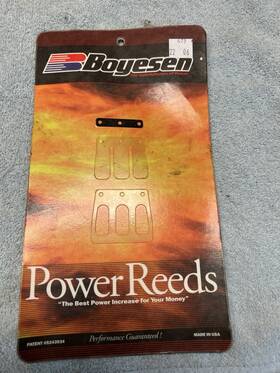
( Brand: Boyesen ), ( Manufacturer Part Number: B006B2VEIS ), ( Compatible Make: Yamaha ), ( Compatible Model: Boyesen Pw80 ), ( Universal Fitment: No ), ( Vintage Part: Yes )
Review BOYESEN Power Reeds fits PW80
The Boyesen B006B2VEIS PowerReeds PW80 is a premium, high-performance reed assembly designed to elevate the playing experience of saxophonists seeking both enhanced projection and refined tonal clarity. Engineered with Boyesen s signature precision and craftsmanship, this reed is crafted from their proprietary PowerReeds material, a blend optimized for durability, responsiveness, and a rich, balanced sound across the entire register. The PW80 offers a medium-hard grade, striking a perfect balance between control and expressiveness, making it ideal for players who demand a dynamic range without sacrificing ease of articulation. Whether navigating the delicate phrasing of a ballad or unleashing the fiery intensity of a jazz solo, the PW80 delivers a consistent, focused tone with exceptional attack and a warm, resonant overtones that bring depth to every note. Its durable construction ensures long-lasting performance, even under rigorous practice sessions or demanding performances, while the smooth, even response minimizes fatigue, allowing musicians to focus on their interpretation rather than the instrument itself. Perfect for intermediate to advanced players looking to refine their sound or for professionals seeking a reliable, high-quality reed for studio work or live performances, the Boyesen PowerReeds PW80 is a testament to Boyesen s commitment to innovation and musical excellence.
### **Pros and Cons of buying a Boyesen B006B2VEIS PowerReeds PW80**
#### **Pros:**1. **High Performance and Power** The PW80 is one of Boyesen s most powerful reed switches, designed for high-current applications (up to 80 amps). This makes it suitable for heavy-duty use, such as in automotive, industrial, or high-power electronics.
2. **Durability and Longevity** Boyesen is known for producing high-quality reed switches with robust construction. The PW80 is built to withstand frequent switching cycles without degradation, making it reliable for long-term use.
3. **Wide Operating Range** It operates effectively across a broad temperature range (-40 C to 125 C), ensuring consistent performance in various environmental conditions.
4. **Fast Response Time** Reed switches like the PW80 are known for their quick activation and deactivation, which is beneficial in applications requiring rapid switching.
5. **Compatibility with Various Sensors** The PW80 can be paired with magnetic sensors, proximity switches, or other magnetic actuation systems, making it versatile for different setups.
6. **Low Power Consumption** Unlike mechanical switches, reed switches consume minimal power when activated, which is advantageous in battery-powered or energy-efficient systems.
7. **Compact and Lightweight** The small form factor of reed switches allows for easy integration into tight spaces without adding significant weight.
8. **No Wear and Tear from Mechanical Contact** Since reed switches use magnetic fields rather than physical contact, they have a longer operational life compared to traditional switches.
---
#### **Cons:**1. **Limited Current Rating for Some Applications** While the PW80 handles up to 80 amps, it may not be sufficient for extremely high-current applications (e.g., heavy-duty industrial motors or high-voltage systems). In such cases, a higher-rated reed switch or alternative switching mechanism may be required.
2. **Sensitivity to External Magnetic Fields** Reed switches can be accidentally triggered by stray magnetic fields, which may cause false activations in noisy environments. Proper shielding or design considerations may be necessary.
3. **Not Ideal for High-Frequency Switching** While reed switches are fast, they are not designed for extremely high-frequency switching (e.g., MHz range). For such applications, solid-state relays or other electronic switches may be more appropriate.
4. **Cost Compared to Simpler Switches** High-performance reed switches like the PW80 are more expensive than basic mechanical switches. For low-power or low-current applications, a cheaper alternative might suffice.
5. **Requires Proper Installation** Improper wiring or installation (e.g., incorrect polarity, loose connections) can lead to failure or reduced lifespan. Careful handling and testing are necessary.
6. **Limited Voltage Rating** The PW80 is typically rated for lower voltages (e.g., up to 250V AC/DC, depending on the model). For high-voltage applications, additional components like snubbers or isolation may be required.
7. **Potential for Arcing in High-Current Applications** While reed switches minimize arcing, high-current switching can still produce minor arcing, which may require additional suppression components to prevent damage.
8. **Not Repairable** Unlike some mechanical switches, reed switches are not easily repairable if damaged. If they fail, replacement is often the only option.
---
### **Conclusion:**The **Boyesen B006B2VEIS PowerReeds PW80** is an excellent choice for applications requiring **high-current, reliable, and durable switching** in moderate to high-power systems. Its strength lies in its **performance, longevity, and versatility**, making it ideal for automotive, industrial, and electronic projects where mechanical switches would fail or degrade quickly.
However, it may **not be the best fit** for **low-power, high-frequency, or extremely high-voltage applications**, where alternative switches (e.g., solid-state relays, mechanical switches, or optocouplers) might be more suitable. Additionally, users must ensure **proper installation, shielding from interference, and compatibility with their specific circuit requirements** to maximize its effectiveness.
---
### **Recommendation:** - **Buy the PW80 if:**- You need a **high-current (up to 80A) reed switch** for automotive, industrial, or electronic projects.
- You require **long-term reliability** in moderate to high-temperature environments.
- You are working with **magnetic sensors or proximity detection** where mechanical switches would be impractical.
- Your application involves **moderate switching speeds** (not ultra-high frequency).
- **Consider alternatives if:**- Your application requires **higher currents than 80A** (e.g., heavy-duty motors, high-voltage systems).
- You need **ultra-high-frequency switching** (e.g., RF circuits, high-speed data transmission).
- Cost is a major concern, and a **lower-cost mechanical or solid-state switch** would work.
- Your environment has **strong external magnetic interference** that could trigger false activations.
For most **moderate to high-power switching needs**, the **PW80 is a strong, dependable choice** just ensure proper integration and testing to avoid potential issues.
Details:
New in packaging.
part #: b006b2veis prices
- $23.33-$26.88
specifications intakefuelmotorcycle:
- brand: Boyesen
- mpn: B006b2veis
- compatible make: Yamaha
- compatible model: Boyesen Pw80
- universal fitment: No
- vintage part: Yes
offer intakefuelmotorcycle:
- quantity: 1
- options: Ship-to-home
- started: February 10, 2026
- best offers: True
- availability: In Stock
- sold: 0
shipping intakefuelmotorcycle:
- carrier: USPS
- transit: 3-10 Days
- service: USPS Ground Advantage
- class: Standard
- cost: $5.07
- type: Calculated
seller intakefuelmotorcycle:
- # reviews: 285
- rating: 100.0%
- city: Waukesha, Wisconsin
payments intakefuelmotorcycle:
- credit card: Mastercard
- other
- wallet: Google-pay
returns intakefuelmotorcycle:
- paid by: Buyer
- time: 14 Days
- policy: Returns Accepted
general intakefuelmotorcycle:
- condition: New
- Motorcycle Scooter Parts Accessories > Air Intake Fuel Delivery > Other Air Intake Fuel Delivery
Boyesen B006B2VEIS Is Similar To:
- 011r Boyesen Power Reeds Reed Petal (60% similar) See if someone else accepted the delivery on your behalf at address. Generic image shown. Boyesen power reeds this item fits the following model's: Kawasaki JS300 1988 1987 1986 300SX 1991 1990 1989 type: reed petal style: dual stage material: fiberglass sold as: each use a patented ...(November 23rd, 2018)
- 012r Boyesen Power Reeds (64.4% similar) Part: power reeds Boyesen 012R applications 1988 Kawasaki JF650 X2 1988 JS650 650SX1989 X21989 TS1990 X21990 650SX1991 JL650 991 X21991 TS1992 650SX1992 992 X21993 650SX1993 993 TS1994 994 X21994 TS1995 995 X21995 TS1996 gifts use a patented dual stage fiberglass design for more air flow, ...(November 10th, 2018)
- Yz Power Reeds Yamaha Boyesen Yz60 11981-1983 60 (33.7% similar) More air flow, more air velocity and more power...(August 5th, 2014)
- 12 Boyesen Watercraft Power Reeds 804429000029 (59.3% similar) Expedited shipping via USPS priority mail with delivery confirmation is available. This occasionally happens, and is rare...(June 7th, 2018)
- 5243934 Boyesen New Pro Series Carbon Reeds Bin (51.2% similar) I really appreciate that. If I am at fault pay return shipping back to me. Boyesen pro series carbon reed 44 CR250 RM250 new in package bin 214 fast free USA shipping. This would make a great item for anyone...(July 14th, 2018)
- Stock Super 568sf1 Reeds Boyesen (32.8% similar) What makes us different let's face it. There are simply too many variables that apply to clothing sizing for the human body. You can even come in and see us at our newly re model ed retail store. Motorcycle market offers the best brand names and the highest quality goods. We, like any technology ...(September 11th, 2014)
- 601 Boyesen Power Reeds Dual Stage Fiberglass 804429002894 (47.3% similar) Improved engine efficiency and fuel economy for the long distance rider. More air velocity. The multi-port feature of bottom reed creates more channels for charge, delivering increased velocity to intake ports. More horsepower throughout the power band for guaranteed performance. Dual-stage reeds ...(May 1st, 2018)
- 603 Boyesen Power Reeds For 665760824718 (56% similar) Boyesen power reeds plus free contrasting sticker fits yamaha YZ80 years 1980 through 1984 use a patented dual stage fiberglass design. More air flow, velocity and power...(July 12th, 2017)
- 604 Boyesen Power Reeds Dual 804429002924 (57.9% similar) Crisper throttle response for fast corner exits and surer jumps. More air velocity. The difference in stiffness between top reed and bottom allow reeds to respond quickly accurately changes engine pressure. The benefits price shown is for one set of reeds. Note: certain model's need to use the stock...(October 31st, 2017)
- 605 Boyesen Power Reeds Dual 804429002931 (57.9% similar) Improved engine efficiency and fuel economy for the long distance rider. More overall power. More horsepower throughout the power band for guaranteed performance. Compare the microfiche for USA model to your be sure they are same. The benefits price shown is for one set of reeds. Note: image may not...(September 1st, 2017)
- 609 Boyesen Power Reeds 1980-1993 804429002986 (54.3% similar) Expedited shipping with delivery confirmation is available. Images are the manufacturer. Expedited shipping via USPS priority mail with delivery confirmation is available. This occasionally happens, and is rare. Return number must be on the outside of box, otherwise package will refused. Actual ...(July 26th, 2017)