SUZUKI 24331-46000 Gear Nt 77-04 3RD
fits model: Rm50, Rm80, Ds80, Jr80. make: Suzuki.
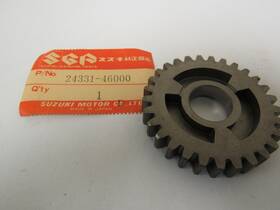
( Manufacturer Part Number: 24331-46000 ), ( Part Type: Gear )
Review SUZUKI Oem 77-04 3rd Driven Gear Nt 29 fits RM50 RM80 DS80 JR80
The **Suzuki RM50/80 DS80/JR80 (1977 2004, 3rd Gear NT-29)** is a legendary off-road motorcycle that embodies the raw, uncompromising spirit of classic dirt bike engineering. Originally designed as a lightweight, high-performance trail and motocross machine, this model particularly the **RM50 (50cc)** and its larger-displacement siblings like the **RM80 (80cc), DS80, and JR80** has earned a cult following among riders who appreciate its simplicity, durability, and timeless appeal. Built between **1977 and 2004**, these bikes were part of Suzuki s early foray into the dirt bike market, where they quickly became favorites for their **aggressive styling, nimble handling, and rugged reliability**, making them ideal for everything from cross-country adventures to competitive motocross.
At the heart of the RM50/80 series lies a **single-cylinder, two-stroke engine** paired with a **5-speed transmission** (though the **3rd Gear NT-29** designation suggests a modified or aftermarket gearing setup for enhanced performance). The **RM50** features a **49.7cc air-cooled engine**, while the **RM80, DS80, and JR80** scale up to **79.8cc**, offering a balance of power and efficiency that was revolutionary for its time. These engines were known for their **high-revving nature**, delivering a thrilling, growling exhaust note that remains iconic among vintage dirt bike enthusiasts. The **NT-29** gearing modification likely referring to a **newer transmission or aftermarket gearing** optimizes the bike s power delivery for better acceleration and climbing ability, making it a favorite for riders who want to push the limits of their classic Suzuki.
The **chassis and frame** of the RM50/80 series are built with off-road durability in mind, featuring a **double-cradle design** that balances weight distribution and rigidity. The **forks** (typically **41mm telescopic**) and **swingarm** are designed to absorb the harshest terrain, while the **disc brake system** (or drum brakes on earlier models) ensures reliable stopping power. The **suspension** is adjustable to some extent, allowing riders to fine-tune the bike for different riding conditions whether it s the rough trails of the desert or the technical jumps of a motocross track. The **lightweight aluminum fuel tank** and **minimalist bodywork** contribute to the bike s **agile, responsive handling**, making it a joy to maneuver at high speeds or through tight corners.
One of the most striking features of the RM50/80 is its **retro yet aggressive styling**, with a **sharp, angular fairing**, **exposed engine components**, and **bold, rounded headlight** that gives it a distinctively vintage look. The **blacked-out or polished chrome details**, depending on the model year, add to its classic appeal, while the **wide, knobby tires** (often **1.75-inch front and 2.25-inch rear**) are built for maximum grip on loose or uneven surfaces. The **seat and ergonomics** are designed for comfort during long rides, though they remain minimalist prioritizing function over luxury, which is a hallmark of Suzuki s off-road philosophy.
For collectors and riders alike, the **RM50/80 (1977 2004)** represents a perfect blend of **Japanese precision engineering and off-road ruggedness**. Whether restored to showroom condition or left in its original weathered state, this bike carries a sense of nostalgia and adventure. Its **modularity** thanks to Suzuki s standardized parts across different years makes it easy to customize, from **aftermarket carburetions** to **exhaust upgrades** and **suspension tuning**. The **3rd Gear NT-29** designation suggests a bike that has been fine-tuned for better performance, whether through original factory modifications or aftermarket enhancements, making it a **highly sought-after specimen** in the vintage dirt bike market.
Whether you're a **motocross competitor**, a **trail rider**, or a **restoration enthusiast**, the Suzuki RM50/80 DS80/JR80 (1977 2004) delivers an unmatched riding experience. Its **timeless design, reliable performance, and cult following** ensure that it remains one of the most beloved classic dirt bikes ever made a true testament to Suzuki s early innovations in off-road motorcycle engineering.
### Pros and Cons of Buying a Suzuki RM50/RM80/DS80/JR80 (1977 2004, 3rd Gear NT29 Engine)
#### **Pros**
1. **Classic Design and Nostalgia** These bikes are iconic from the 1970s and 1980s, appealing to enthusiasts who appreciate vintage off-road machinery. The retro styling and simple mechanics evoke a sense of adventure and simplicity.
2. **Lightweight and Maneuverable** The RM50/RM80/DS80/JR80 are designed for agility, making them easy to handle in tight trails, rocky terrain, or urban environments. Their small size and low weight (around 100 120 kg) make them ideal for riders of all ages and skill levels.
3. **Simple and Reliable Engine** The **NT29 290cc 2-stroke** engine (or similar variants) is known for its durability and straightforward maintenance. With proper care, these engines can last decades, especially if they ve been well-maintained. The lack of complex electronics or fuel injection means fewer things can go wrong.
4. **Affordable to Purchase and Maintain** Compared to modern dirt bikes, these bikes are relatively inexpensive to buy, often ranging from a few hundred to a couple of thousand dollars depending on condition. Parts are widely available, and labor costs are low since mechanics familiar with 2-stroke engines are common.
5. **Great for Learning** The low power (around 10 15 HP) and lightweight nature make them excellent for beginners or riders looking to develop foundational off-road skills without overwhelming power.
6. **Off-Road Capability** While not as advanced as modern bikes, they handle rough terrain well, especially on dirt trails, gravel roads, or light rock crawling. Their simple suspension (if intact) and lack of heavy bodywork allow for better articulation.
7. **Customization Potential** These bikes are popular in the custom and restoration scene. Owners can easily modify them with aftermarket parts, such as performance carburetets, upgraded forks, or aesthetic changes, to suit their preferences.
8. **Low Environmental Impact** 2-stroke engines, while less efficient, produce fewer emissions than modern 4-stroke bikes (especially older ones), making them a more environmentally friendly choice for casual riding.
9. **Community and Enthusiasm** There s a strong community of owners who share tips, modifications, and restoration projects. This can be a great resource for troubleshooting or finding parts.
10. **Fun and Unpretentious Riding Experience** These bikes strip away modern distractions (like ABS, traction control, or digital dashboards) and offer a pure, unfiltered riding experience focused on skill and connection with the machine.
---
#### **Cons**
1. **Outdated Technology** The **NT29 engine** (and similar variants) lacks modern advancements like fuel injection, electronic ignition, or advanced suspension systems. This means:
- **Poor fuel efficiency** 2-stroke engines consume fuel at a high rate (often 1:12 or 1:15 oil-to-gas mix), making them expensive to run.
- **Higher maintenance** Regular oil changes, valve adjustments, and piston inspections are necessary to prevent engine wear.
- **Less power and torque** Modern bikes offer significantly more power (even small 250cc 4-strokes surpass these in performance), making them feel underpowered by today s standards.
2. **Poor Fuel Economy** Expect to burn through gas quickly, especially if riding aggressively. The lack of fuel injection means the bike is sensitive to fuel quality, which can lead to clogged carburetors or poor performance.
3. **Limited Comfort and Ergonomics** These bikes were not designed with long-distance comfort in mind. The seating position is aggressive, and the lack of modern suspension tuning means rough rides can be uncomfortable over time.
4. **Reliability Issues with Age** Many of these bikes are **20 years old**, and if not properly maintained, they may suffer from:- **Worn-out bearings, bushings, or chains** These parts degrade over time and require frequent replacement.
- **Rust and corrosion** If stored improperly, the frame, suspension, and engine components can rust, leading to structural weakness.
- **Electrical problems** Older wiring and ignition systems can fail, especially if exposed to moisture.
5. **Safety Concerns** Modern bikes come with **disc brakes, better suspension, and improved handling**. These older bikes often have:- **Drum brakes** (on some models), which are less effective in stopping power.
- **Weak or worn suspension** that doesn t handle modern trail conditions well.
- **No or poor protection** (no fairings, minimal wind protection, and no modern safety features like traction control).
6. **Environmental and Legal Issues** In many regions, **2-stroke engines are banned or restricted** due to emissions regulations. While some areas allow them for off-road use, riding on public roads may be illegal without modifications (like catalytic converters, which are impractical for these bikes).
7. **Limited Aftermarket Support** While parts exist, they may be harder to find than for modern bikes. Some components (like OEM suspension or carburetets) are discontinued, requiring aftermarket replacements.
8. **No Modern Conveniences** Features like **digital speedometers, kickstands, or even reliable kickstarters** may be missing or unreliable. Some models require a pull-start, which can be tedious after long rides.
9. **Resale Value** These bikes do not hold value well. Even in good condition, they depreciate quickly compared to modern or well-maintained classics.
10. **Skill-Dependent** The low power means **technique and body control** are crucial for control. A rider who isn t comfortable with a lightweight, underpowered bike may struggle with acceleration and stability.
---
### **Conclusion**
Buying a **Suzuki RM50/RM80/DS80/JR80 (1977 2004, NT29 engine)** is a **great choice** if you:- **Appreciate vintage machinery** and enjoy the nostalgia of riding a piece of off-road history.
- **Prioritize simplicity and low maintenance** over modern performance.
- **Plan to use it for light trail riding, learning, or customization projects**.
- **Are willing to invest time in maintenance** to keep the bike running smoothly.
- **Don t need high power or long-distance comfort**.
However, it is **not ideal** if you:- **Want a bike for serious off-road racing or heavy-duty use** (modern bikes offer better power and durability).
- **Need reliable, low-maintenance transportation** (these bikes require frequent upkeep).
- **Plan to ride on public roads** (emissions and legal restrictions may apply).
- **Prefer modern safety and comfort features** (disc brakes, better suspension, ergonomics).
---
### **Recommendation**
If you re **serious about buying one**, follow these steps to maximize your experience:1. **Inspect Thoroughly** Check for **rust, engine wear, suspension condition, and chain/belt health**. A good test ride is essential to ensure the bike handles well.
2. **Budget for Maintenance** Expect to spend **$500 $1,500 per year** on parts, oil, and occasional labor, depending on usage.
3. **Consider a Restoration Project** If the bike is in rough shape, factor in the cost of bringing it back to running condition (new chain, bearings, carburetor, etc.).
4. **Ride Responsibly** These bikes are **not for high-speed riding** or aggressive off-roading. Treat them as **training bikes** or hobby projects rather than performance machines.
5. **Join the Community** Engage with **Suzuki RM/DK owners groups** (online forums, Facebook groups) for advice, part sourcing, and troubleshooting.
6. **Store Properly** If not ridden frequently, **use a fuel stabilizer, cover the bike, and check fluids** to prevent deterioration.
**Final Verdict:**- **Buy it if** you love the classic feel, want a low-cost project bike, or are drawn to the simplicity of 2-stroke riding.
- **Avoid it if** you need a reliable, high-performance, or modern off-road machine.
For most riders today, these bikes are **best suited as hobby projects, training tools, or nostalgic rides** rather than primary off-road machines. If you re willing to embrace their quirks, they can be incredibly rewarding. If you want a bike that s **easy to ride, maintain, and perform well**, a modern **250cc 4-stroke** (like a Honda CRF250L or Yamaha WR250R) may be a better long-term investment.
Details:
Model lists are for reference only and may not be complete. Kurt 2 0225brand new nos genuine Suzuki gear.
part #: 2433146000 prices
- $19.75-$28.99
specifications intakefuelmotorcycle:
- for models: Rm50, Rm80, Ds80, Jr80
- for makes: Suzuki
- mpn: 24331-46000
- part type: Gear
seller intakefuelmotorcycle:
- rating: 100.0%
- city: Houston, Texas
- # reviews: 1176
general intakefuelmotorcycle:
- condition: New
- Motorcycle Scooter Parts Accessories > Air Intake Fuel Delivery > Other Air Intake Fuel Delivery
shipping intakefuelmotorcycle:
- transit: 4-10 Days
- cost: $8.10
- class: Standard, Expedited
- carrier: USPS, FedEx
- service: USPS Ground Advantage, USPS Priority Mail, FedEx Ground / FedEx Home Delivery
- type: Calculated
offer intakefuelmotorcycle:
- quantity: 9
- started: March 1, 2026
- availability: In Stock
- sold: 0
- options: Ship-to-home
returns intakefuelmotorcycle:
- time: 30 Days
- paid by: Seller
- policy: Returns Accepted
payments intakefuelmotorcycle:
- credit card: Diners-club
- wallet: Paypal
- other
Suzuki 24331-46000 Is Similar To:
- 08-301sk Moose Racing Yamaha Motorcycle Gear Torque Spacer Kit Suzuki (23% similar) ...(November 23rd, 2018)
- 09491-22015 Suzuki Pc Genuine Nos Carburetor Main Jet Oem Size (21.2% similar) The actual item is shown. Authenticity:every item I sell is 100 authentic. Up for sale is this genuine suzuki needle jet part as shown only - seen in the above photos. This is in nos unused condition although the packaging may show wear. Please feel free to ask any questions about this item. Free ...(June 23rd, 2018)
- 11115-45722 11115-45740 Suzuki Gs Vs Vl Dr Sp Valve Guide Intake Oem (15.9% similar) Perfect for a restoration project. Up for sale is an oem. This part is brand new. Suzuki valve...(October 4th, 2018)
- 12-94020 Emgo Suzuki Air Filter Cleaner Element Gs New Oem Equal (19.4% similar) Your friends at classic cycle parts appreciate business...(November 27th, 2018)
- Set Suzuki 89-96 1991 12000-17810 Gsx750f Katana Crankshaft Oem (24.1% similar) Item is in good, working condition. We'd be happy to answer your questions. Condition item may have light scratches, scrapes, dents or markings. Part number part number is included so that you can compare this item against your motorcycle. Free shipping. Have any questions feel free to ask. This ...(January 3rd, 2015)
- 13101-05h00 Suzuki Pipe Assembly Intak New Oem 718721431576 (23.3% similar) The picture could be generic. New oem suzuki pipe assembly intake part number: 13101-05H00ITEM only fits specific model's listed...(March 17th, 2018)
- 13101-11h00 Suzuki Pipe Assembly Intak New Oem 718721431668 (23.3% similar) New oem suzuki pipe assembly intake part number: 13101-11H00ITEM only fits specific model's listed. The picture could be generic...(March 17th, 2018)
- Gs700 1983 09402-50208 Suzuki Genuine Boots 13110-31310 13120-31310 09280-38004 Oem Intake 1985 F79 Manifold Gs750es (28% similar) When appropriate we mark them as repair or personal use items. Also, colors may be different in other countries so please verify your color, size dimensions, and part number before purchase. Approximate boot dimensions for reference length 27MMI. Last photo is an exploded drawing showing ...(December 5th, 2014)
- Intake Suzuki Gs550e 13110-43400 Manifold Oem Gs550es F77 Carb 83-86 Genuine Boots 13120-43400 (41.5% similar) Last photo is an exploded drawing showing components included. The set includes 2 special double throat manifold boots, 4 o rings, and 2 special oval clamps. When appropriate we mark them as repair or personal use items. This is a new genuine suzuki intake manifold set for the GS550E and GS550ES see...(January 23rd, 2015)
- Suzuki Gs850g X2 Genuine Manifold Oem rings 80-83 Intake 13120-45100 X4 Kit X2 E30 Boot 09280-38004 13110-45100 Gl (30.3% similar) Items were taken out of the package for pictures only and are in fresh condition. Approximate boot dimensions for reference length 34MMI. Also, colors may be different in other countries so please verify your color, size dimensions, and part number before purchase. The vacuum port screw and washer...(September 20th, 2014)
- 13110-46000 Oem Suzuki Rm80 Ds80 (45.1% similar) This is a very nice nos intake manifold...(December 24th, 2017)